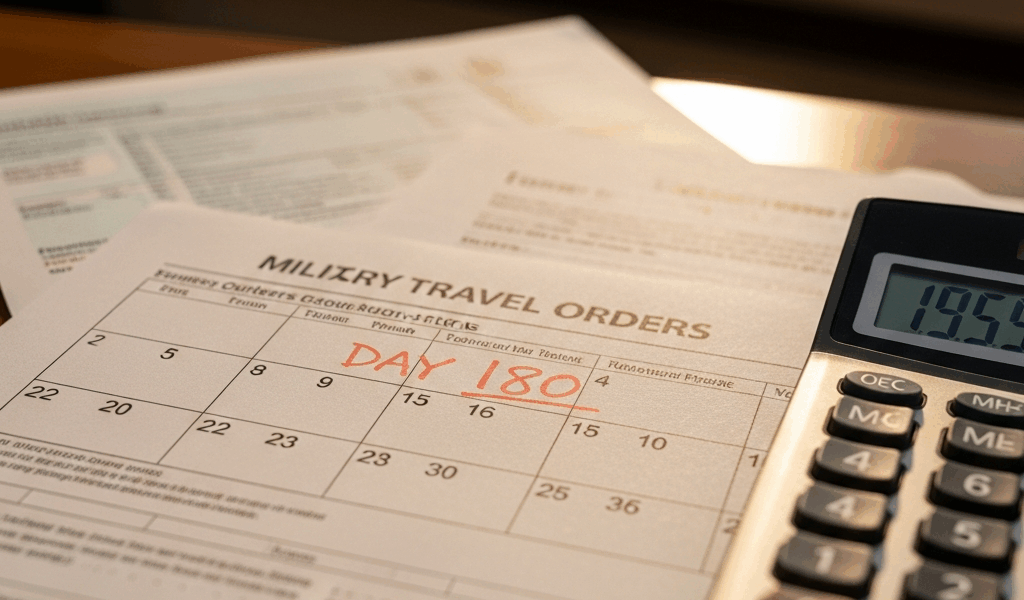
Why 180 Days Is the Line That Changes Everything
TDY extensions past 180 days have gotten complicated with all the conflicting information flying around. As someone who learned this lesson the hard way — a 14-month extension I never saw coming — I learned everything there is to know about what happens when that threshold hits. Today, I will share it all with you.
The 180-day mark isn’t arbitrary. It’s the exact point where both the IRS and the Department of Defense flip a switch on how they categorize your assignment. Before you cross it, your TDY location is temporary. You’re still legally a resident of your home of record. Per diem stays at full rates. Travel reimbursements stay tax-free. Simple enough.
Cross day 180 at the same location? The IRS starts questioning whether you’ve established a new tax home. The DoD cuts your per diem in half. Your wallet gets lighter. Your tax filing gets messier. This isn’t theoretical — this is real money leaving your household every single month.
But what is a tax home, exactly? In essence, it’s the principal place where you work or do business — not necessarily where you sleep at night. But it’s much more than that. For service members, it’s usually the official duty station or home of record, whichever carries stronger economic ties. Stretch a TDY indefinitely or past a full year, though, and the IRS can decide your tax home quietly relocated to wherever you’re currently living. Reimbursements that were tax-free under temporary duty rules? Suddenly taxable income.
What Happens to Your Per Diem After Day 180
DoD policy on this is blunt. After 180 consecutive days at the same temporary duty location, lodging per diem drops to 55 percent of the full rate. Meals and incidental expenses — M&IE — drop to 55 percent as well. That’s not a minor rounding adjustment. That’s a hard cut that hits the same day, every time.
Real numbers make this land differently. Say you’re on TDY in San Antonio. Full per diem runs $180 daily for lodging, $60 for M&IE — $240 total, roughly $7,200 a month. On day 181, lodging drops to $99. M&IE drops to $33. You’re now pulling in $132 daily, or about $3,960 monthly. That’s a $3,240 monthly loss. Over twelve months, that’s nearly $39,000 absorbed somewhere in your budget. It compounds fast.
The question I hear constantly is whether DTS auto-adjusts this rate or whether finance has to manually update it. Honest answer: depends entirely on your branch and whether your Authorizing Official enters amended orders correctly. Some installations auto-calc. Others absolutely do not. I’ve talked to soldiers whose DTS kept paying full rate for weeks past day 180 because nobody flagged the date change — and when finance reconciled, they had to pay every dollar back. Sometimes with an overpayment flag attached.
Your Authorizing Official and finance office are technically supposed to flag this transition. Don’t count on it. Pull your DTS record yourself around day 175. Confirm the rates. Confirm the order effective dates. Then send finance a direct email asking them to verify the day-181 adjustment is queued. That email thread becomes your protection if something goes sideways later. Don’t skip this step.
The Tax Home Problem and How to Protect Yourself
Probably should have opened with this section, honestly. The tax home issue is the one that sneaks up on people — the IRS doesn’t send a letter explaining what’s changed. You just find out during audit season when it’s already too late to fix cleanly.
When a TDY stretches from “temporary” into indefinite or one-year-plus territory, the IRS can reclassify your tax home to your TDY location. From that point, any travel between your old home and your TDY site becomes non-deductible commuting expense. The DoD reimbursements for those trips — previously tax-free — flip to taxable income you’re now required to report. It’s a quiet reclassification that costs real money at filing time.
The defense is documentation. Keep paying your mortgage or rent at your home of record — every month without a gap. Keep utilities active under your name. File state taxes as a resident of your home state. Register your vehicle there. Keep your driver’s license current at that address. These aren’t bureaucratic formalities. They’re an evidence trail the IRS actually respects when someone’s doing an audit review.
Most important step: talk to a military tax advisor before filing for the year your TDY exceeded 180 days. Not a generic H&R Block — a firm that actually knows military tax rules. MilTax is a solid starting point. I’m apparently someone who learned this through trial and expensive error, and MilTax works for me while the generic prep chains never quite caught the nuances. Don’t make my mistake. A proper military tax advisor runs a few hundred dollars. An audit runs thousands and drags on for years.
Steps to Take the Moment Orders Get Extended Past 180 Days
The day you get word your orders are extended, move immediately. The system does not handle this automatically — at least not reliably enough to trust without verifying.
- Notify your Authorizing Official immediately. Give them the exact calendar date your 180-day mark hits and ask them to confirm amended orders are filed with finance. Get it in writing — even a reply email is enough.
- Update DTS yourself. Log in, check your assignment end date, and if the extension isn’t reflected yet, submit a request to update it. Attach a copy of your amended orders directly to the request so there’s no ambiguity.
- Check your housing situation before day 181 arrives. If you’ve been in a hotel under TLE — Temporary Lodging Expense — understand that TLE typically ends right at the 180-day mark. You may shift to civilian housing under the reduced 55 percent rate, or you may qualify for government quarters. The difference matters in your monthly budget. Find out early.
- Contact your finance office directly. Ask explicitly whether the per diem rate reduction is queued for your record and confirm the exact date it takes effect. Ask for written confirmation of the new daily rate. Keep that confirmation somewhere accessible.
- Flag the extension with a military tax advisor now — not in April. They need lead time to gather documentation and build a defensible tax home position if your situation requires it. Give them months, not days.
Common Mistakes That Cost Money on Long TDY Extensions
Assuming DTS auto-adjusts is probably the most expensive mistake on this list. It doesn’t always. Verify the rate yourself around day 175 — every time, no exceptions.
Not updating your home-of-record documentation is the slow bleed. Every month you go without an active bill, an active registration, or an active lease at your true home, your tax home defense gets weaker. Keep it active. That’s the whole job.
Failing to keep lodging receipts once per diem drops to 55 percent is a mistake I see constantly. You’re now paying for housing above your reimbursement ceiling — every dollar over that ceiling is potentially deductible. Keep every receipt, dated and organized. Your tax advisor will need them.
Missing the window to request exceptions is another one that stings. Some commanders can approve exceptions to the 55 percent reduction if you can demonstrate the reduced rate makes the assignment genuinely unworkable — but that request has to come before day 180. Not after. Some installations also offer government quarters that cushion the financial hit, but getting into them takes coordination time you don’t have if you wait until day 179.
Not reading amended orders line by line is the last one. Extensions sometimes carry changes to your duty location, your home-of-record status, or your authorization category buried in the language. Those changes affect per diem and tax treatment independently. Read every line. That’s what makes this process so relentlessly unforgiving for people who skim.
The 180-day threshold exists because the system is designed to eventually transition extended TDY into permanent change-of-station status. That’s the intent. But ignore the mechanics of it — the documentation, the DTS verification, the tax home paper trail — and it stops being a policy and starts being a penalty. Stay ahead of it.




Leave a Reply