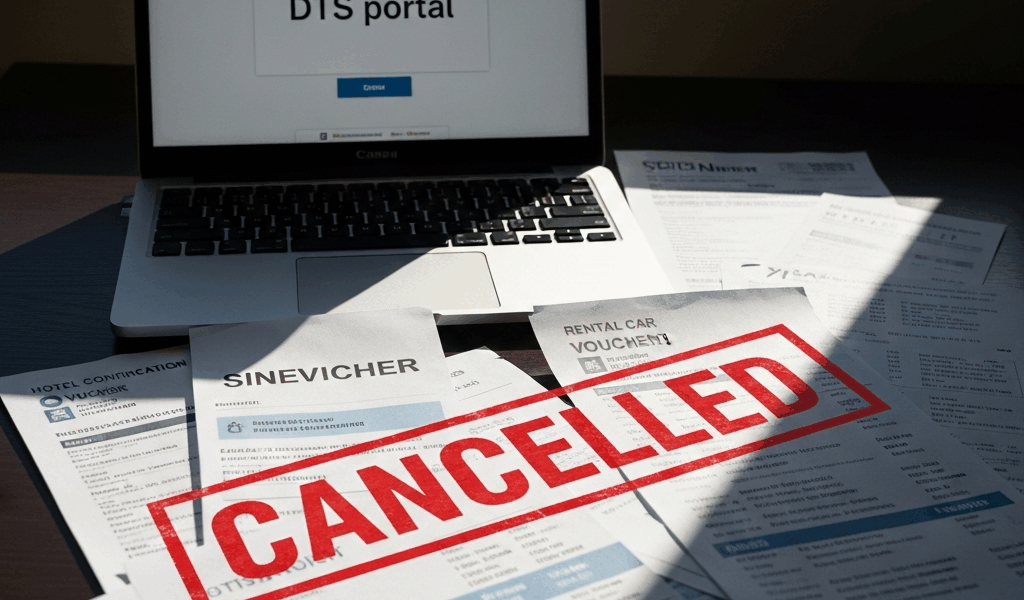
Why Cancelled TDY Creates a Reimbursement Mess
Military travel reimbursement has gotten genuinely complicated with all the misinformation flying around about what happens when TDY gets cancelled mid-booking. As someone who has navigated DTS cancellations, non-refundable hotel penalties, and finance office pushback firsthand, I learned everything there is to know about recovering those costs. Today, I will share it all with you.
Picture this: flights locked in through DTS, a hotel confirmation sitting in your inbox, a rental car reserved for 0900 pickup. Then the mission shifts. Orders change. Funding evaporates. And suddenly you’re holding non-refundable bookings for a trip that will never happen.
That’s what makes this scenario so maddening to us service members — the military travel system doesn’t automatically reverse itself. DTS doesn’t call the hotel. Your government travel card doesn’t quietly refund the $180 non-refundable rate you locked in at the La Quinta off base. The authorization just sits there, approved and untouched. Finance has no idea. Your chain of command has moved on. And you’re left staring at your inbox wondering whether you personally owe money for travel that command officially cancelled.
Probably should have opened with this section, honestly — because this is where the panic usually sets in.
The military distinguishes hard between refundable and non-refundable rates. Government contract rates? Usually refundable. That discounted Marriott Bonvoy rate you hunted down yourself? Non-refundable, with a cancellation penalty baked in. DTS doesn’t automatically track which type you booked. Finance won’t know what you paid or what the cancellation terms were unless you spell it out for them. And they will not volunteer reimbursement for fees they don’t know about.
The voucher doesn’t submit itself. The authorization doesn’t close itself. Without your action, this becomes a dangling liability — one that can follow your record for months.
Step One — Cancel Everything in DTS Immediately
The moment word comes down that TDY is cancelled, open DTS. Not tomorrow morning. Not after a conversation with your travel office. Now. Find the active authorization for that trip and pull it up.
Navigate to Authorizations. Locate the approved one. Find the Cancel button. Most service members skip this entirely — they assume the authorization dissolves once the travel dates pass. It doesn’t. An authorization can sit in “Approved” status indefinitely, completely untouched, like it’s waiting for a trip that’s never coming.
Click Cancel Authorization. DTS will prompt you for a reason. Select “Mission Change” or “Orders Modification,” whichever fits your situation. That selection creates an audit trail proving the cancellation wasn’t your call. That matters — a lot — when you later file for unavoidable fees.
Booked through DTS using government contract rates at properties like the La Quinta or base lodging? Those cancellations typically flow back to the vendor automatically once the authorization is cancelled. Full refund within 7 to 14 days. Straightforward.
Booked outside DTS on your personal government travel card — say, a flight through a third-party site or a hotel reservation made directly? Cancelling the DTS authorization does nothing to those bookings. You have to call the airline, the hotel, the rental car company yourself. That’s the scenario that creates real financial headaches. Non-refundable rates carry penalties, and those penalties are exactly what you’ll recover through the voucher process later — if you document everything correctly.
Missing the cancellation window doesn’t disqualify you from reimbursement. But it slows everything down considerably. If the authorization expires naturally after the travel dates pass without a formal cancellation on your end, Finance treats it as completed travel that generated zero expenses. You’ll end up submitting a manual voucher with a written explanation attached. More questions. More delays. Don’t make my mistake and skip this step assuming someone else will handle it.
How to Handle Non-Refundable Hotel and Flight Fees
But what is a reimbursable cancellation cost, exactly? In essence, it’s any unavoidable fee charged by a vendor when official travel gets cancelled through no fault of the traveler. But it’s much more than that — it’s a documented, policy-backed claim with a specific JTR citation behind it.
The Joint Travel Regulations — the JTR, basically the travel bible for anyone touching federal travel funds — actually covers this scenario directly. Section 020105-B states that when travel is officially cancelled due to circumstances beyond the traveler’s control, unavoidable cancellation costs are reimbursable. That’s the citation you’ll need later.
The key word is unavoidable. You locked in a non-refundable rate because you were following orders and booking in good faith. You didn’t cancel to avoid the trip. The government cancelled on you. That distinction is enormous.
Reimbursable: the actual cancellation fees charged by the vendor. Paid $320 for a Delta flight with an $85 cancellation penalty? You claim the $85. Hotel charged a full-night penalty of $180 for a non-refundable booking? Claim the $180. Rental car company hit you with a $50 early termination fee? Same process.
Not reimbursable: the original fare if you retained travel credit from it. You don’t pocket $320 in flight credit and then claim full reimbursement on top of it. You get the actual out-of-pocket loss — nothing more, nothing less.
Documentation is everything here. Original booking confirmation. Cancellation confirmation showing the fee amount. The email or memo stating TDY was cancelled by command. The orders change document. Screenshot everything. Download PDFs. Print backups. Don’t rely on vendor websites that routinely scrub old booking records after 90 days.
Filing a Voucher for a Trip You Never Took
So, without further ado, let’s dive into the part that confuses almost everyone — submitting a voucher for travel that never actually happened.
I’m apparently the kind of person who assumed Finance would figure this out on their own, and that approach never worked once. You have to submit a voucher specifically to recover cancellation fees. The cancelled authorization doesn’t trigger reimbursement. Only the voucher does.
Open a new voucher in DTS. Link it to the cancelled authorization. Here’s the critical step: zero out the actual travel expenses — because there weren’t any. Don’t enter lodging costs for dates you never stayed. Don’t claim per diem. But do create individual line items for every cancellation fee you paid.
In the itemized expenses section, list each one separately. Hotel cancellation penalty: $180. Delta flight cancellation fee: $85. Rental car early termination: $50. Attach supporting documentation to every single line item. Be specific — name the vendor, describe the fee, explain why it was charged.
In the remarks section, write something like: “Voucher filed to recover unavoidable cancellation fees. TDY cancelled via order modification dated [date]. Bookings made IAW DTS authorization [number] and cancelled [date] due to mission requirements.”
Submit it before closing the authorization. Close the authorization without a voucher and you’ve locked in the financial loss yourself. The system will mark the trip complete, record zero expenses, and make zero reimbursement available. That door closes permanently.
What To Do If Finance Pushes Back on the Claim
Finance says you should have booked refundable rates. Or they say you’re claiming reimbursement for travel that never occurred. This happens more than it should — and it’s genuinely infuriating when you followed every step correctly.
Request reconsideration in writing. Immediately. Include the orders change memo proving the cancellation was a command decision, not a personal one. Cite JTR Section 020105-B by name. Then write something close to this:
“The traveler is not liable for cancellation penalties incurred when official travel orders are cancelled due to mission changes outside the traveler’s control. The booking was made IAW authorized DTS authorization on [date]. Cancellation was mandatory upon receipt of orders modification on [date]. Vendor cancellation fees represent direct costs of the mission change and fall within reimbursable travel expenses per JTR policy.”
Send that to your finance office — and copy your travel office on the same email. If the denial stands, escalate to your servicing travel management company. They carry actual authority in these disputes. Individual finance clerks, however well-meaning, often don’t have full visibility into JTR reimbursement policy for cancelled travel scenarios.
You are not liable for these fees. The government is. Make that distinction clear, make it documented, and don’t back down from it.




Leave a Reply