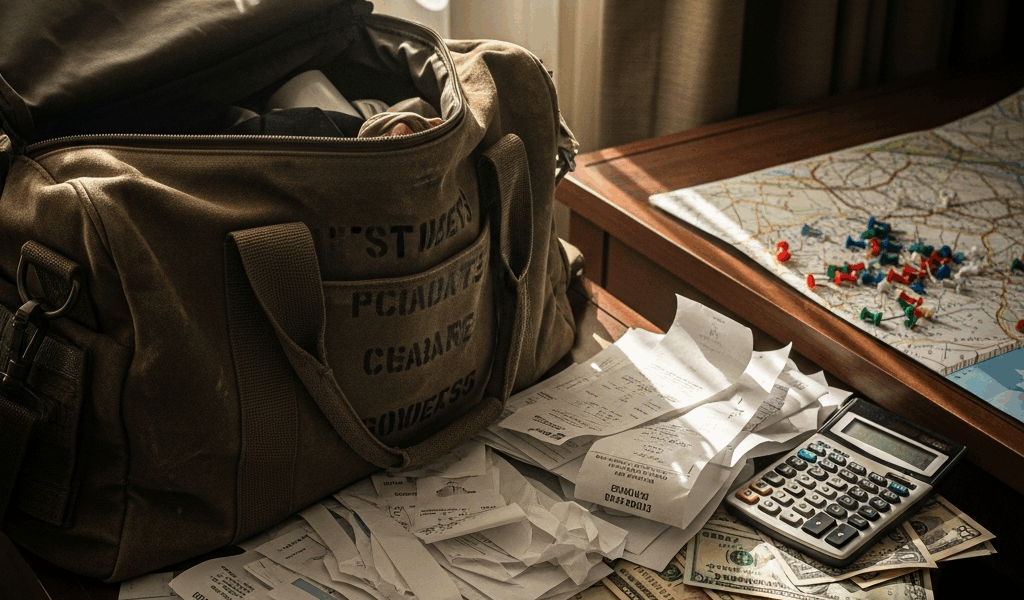
How TDY Per Diem Actually Works
TDY per diem has gotten complicated with all the bad advice flying around—half of it from finance clerks who’ve never deployed, the other half from senior NCOs who learned wrong and taught wrong ever since. As someone who’s completed thirty-seven TDYs across fifteen years of service, I learned everything there is to know about how this money actually moves. Some of those trips lasted three days. One dragged on for six months. What I kept noticing—assignment after assignment—is that most military members don’t really understand what they’re entitled to, which means real money disappears every single time.
The structure is more layered than people assume. Worth breaking down properly.
TDY per diem splits into two distinct pieces: lodging and meals & incidental expenses (M&IE). They work differently. They’re taxed differently. And honestly, how you handle each one determines whether you pocket an extra $800 or a measly $200 on a two-week assignment.
The Lodging Piece
Lodging gets reimbursed up to a specific ceiling set by the Joint Travel Regulations (JTR)—location by location. Las Vegas? $199 per night. Rural Kansas? $89. Find a hotel for $119 in Vegas, you get reimbursed $119 and keep nothing extra. Find one for $79, same story—$79 back, zero pocketed. The lodging side doesn’t generate savings unless you stay somewhere for free, which is rare and brings its own paperwork headaches.
The real win lives on the M&IE side.
M&IE—The Flat Rate You Actually Keep
This is what most people miss entirely. M&IE is a flat daily rate—not reimbursable based on receipts, no documentation of what you spent it on. The government hands you, say, $67 per day in a medium-cost area, and whatever you don’t spend on food and minor incidentals stays in your pocket. Spend $35? You keep $32. That’s the legal arbitrage, sitting right there in plain sight.
Probably should have opened with this next part, honestly: the first and last day rule. On your TDY start date and end date, you only collect 75% of the daily M&IE rate. A $67/day rate becomes $50.25 on day one and day thirty. Plan your meals differently on those calendar edges—it matters more than people think.
Here’s the actual math on a fourteen-day TDY to a city with a $65 M&IE rate.
- Day 1: $65 × 0.75 = $48.75
- Days 2-13 (12 days): $65 × 12 = $780
- Day 14: $65 × 0.75 = $48.75
- Total M&IE entitlement: $877.50
Spend $450 on actual food, coffee, and late-night Uber Eats—you pocket $427.50. That’s the whole game, right there. Reduce food spend, stay fed, don’t do anything that looks like fraud. Simple in theory. Takes some discipline in practice.
Lodging Strategies That Save Real Money
Frustrated by overpriced hotels clustered near base, I started digging into every legal alternative about two years into my TDY rotation—a Tuesday afternoon in a Hampton Inn in Biloxi, Mississippi, calculator app open, absolutely done paying full price. That’s when the real savings started.
The obvious play is booking at or below the government per diem rate. Every TDY location publishes a maximum lodging allowance. Finding something at that ceiling isn’t the hard part. Finding something at that ceiling that doesn’t make you question your life choices—that’s the challenge.
Government Rate Hotels—The Default Play
La Quinta, Red Roof, select Motel 6 locations, certain Holiday Inn Express properties—these participate in government programs and already know the per diem rates. They’ll often offer them without you even asking. Book through government travel booking platforms like Priceline for Government, or directly through reservation systems integrated with DTS. None of these are luxury situations. The rooms are clean. The Wi-Fi holds. You’re not there to impress your family.
Extended Stay Properties—The Underutilized Option
This is where things get interesting on TDYs running longer than five days. Extended Stay America. Candlewood Suites. Motel 6 extended stay locations. These properties typically charge less per night than standard hotels—partly because you’re not paying for daily housekeeping nobody wants anyway. Your room has a kitchenette. That matters enormously, which I’ll explain shortly. A property in Oklahoma City might run $75/night where a comparable standard hotel sits at $89. That’s $14 saved per night—multiply by ten days and you’ve got $140 extra before you even touch the M&IE strategy.
Split Lodging With a TDY Buddy
Two service members, one two-bedroom apartment or suite. You each claim the full per diem rate. Lodging cost splits down the middle. On a $150/night allowance, finding a two-bedroom for $220 means you’re each paying $110—$40/night saved on lodging. Over fourteen days, that’s $560 per person. Your buddy pockets the same. This is legal. The JTR explicitly allows it. Not a gray area.
Don’t make my mistake—vet your roommate first. I once shared a setup with someone who rebooked his flight five separate times. We ended up covering extra nights he didn’t actually use. The savings evaporated. Know who you’re partnering with before you sign anything.
Airbnb—When Your Command Allows It
Some commands approve Airbnb and similar platforms. Check your specific orders before assuming anything. When it’s permitted, entire apartments frequently come in under the hotel per diem rate. A one-bedroom in Shreveport, Louisiana might list at $65/night on Airbnb while the hotel rate runs $78. You save $13/night—and more importantly, you get a kitchen. That kitchen is what makes the M&IE strategy I’m about to explain actually executable.
M&IE — This Is Your Money to Keep
But what is M&IE, really? In essence, it’s a flat daily allowance meant to cover meals and minor expenses like laundry, tips, and local transit. But it’s much more than that—it’s the primary mechanism through which a disciplined service member legally profits from a TDY assignment. Understanding the structure is what separates the people who come home with $400 from the ones who come home with $3,000.
The Flat Rate Structure
M&IE arrives as a single daily number. In 2024, rates run from $54 to $69 per day depending on location. That money is yours. No receipts required. No audit trail tracking what you actually ate. The government assumes you’ll use it on meals and minor incidentals—and you should, broadly speaking—but if you spend $30 instead of $65, you keep the difference. It’s also worth noting that per diem allowances carry preferential tax treatment compared to ordinary income. That distinction adds up over a long assignment.
Why Eating at the DFAC Saves More Than You Think
Access to a dining facility on your TDY location? Use it—breakfast and lunch, every day. DFAC meals run free for active duty. Two meals covered daily, no cost to you. Your $65/day M&IE now only needs to stretch across dinner and maybe a coffee. Spend $20 on dinner. Pocket $45. Over fourteen days, that’s $630 sitting in your account that wasn’t there before.
DFAC access varies by location—not every TDY puts you near one. But when it’s available and you skip it, you’re leaving real money behind for no reason.
Grocery Store Meal Prep at Extended Stay
Extended stay kitchenette plus a nearby grocery store equals the most reliable M&IE savings available. Eggs, bread, peanut butter, bananas, chicken breast, a bag of rice, broccoli, and a container of ground coffee. That’s a ten-day food supply for roughly $95—I did exactly this during a TDY to Fort Rucker, Alabama, in 2019. Breakfasts I made myself, packed lunches, one real dinner out each evening. With a $65/day rate, I pocketed close to $600 on M&IE alone across ten days.
That’s what makes the extended stay option so endearing to us TDY veterans. The kitchenette isn’t a luxury—it’s a financial instrument. Standard hotel rooms don’t have them. That single difference shapes your entire strategy.
Long TDY vs Short TDY — Different Strategies
A three-day trip to DC and a forty-five-day assignment in Alabama are entirely different financial situations. Treating them the same is where people lose money.
Short TDY — Three to Seven Days
Don’t overthink it. Book a hotel within the per diem rate. Eat at the DFAC when possible, nearby restaurants otherwise. You’ll probably pocket $200-$300 total if you’re disciplined. That’s fine. The absolute dollar amounts on a short TDY don’t justify elaborate optimization—spend your energy on the longer assignments where the math actually moves.
Long TDY — Thirty Plus Days
This is where everything shifts. After thirty days, the JTR transitions you from a daily M&IE rate to a flat monthly figure—the “30-day rule.” Instead of $65/day, you might receive $1,900 for the entire month. Same rough total, different psychology—and some locations actually produce a monthly rate that edges out better per-day than the straight daily calculation. Check your specific orders carefully.
Furnished apartments become genuinely viable at this point. A decent one-bedroom furnished apartment in most non-coastal cities runs $900-$1,200/month. If your lodging per diem comes out to $150/day × 30 days = $4,500, the math gets interesting fast. Rent a real place and pocket $3,000-$3,600 in lodging savings—legally, cleanly, with your own kitchen and a parking spot.
The Break-Even Calculation
Here’s a real example. Thirty-day TDY to San Antonio, Texas.
- Lodging per diem: $120/day × 30 = $3,600
- Market rate for furnished one-bedroom: $1,100/month
- Lodging savings: $2,500
- M&IE: $56/day × 30 days = $1,680 (minus first/last day adjustment = $1,631.20)
- Actual food spend with grocery shopping and DFAC access: $400
- M&IE savings: $1,231.20
- Total pocketed on that assignment: $3,731.20
I ran exactly this assignment in 2021—found a furnished one-bedroom off Loop 410, stocked the fridge from the H-E-B down the street, hit the DFAC on Lackland when I could. That $3,731 knocked out a car payment and padded my leave accrual balance. Most service members on that same TDY apparently walked away with $400-$600 because they defaulted to hotels and restaurant meals without thinking it through.
What NOT to Do — Staying Legal
Probably should have opened with this section, honestly. The fastest way to end a career isn’t a bad performance review—it’s mishandling government travel funds.
Falsifying Receipts Is Fraud
Don’t fake hotel receipts. Don’t claim a more expensive property than you stayed at. Don’t submit receipts for your spouse’s meals dressed up as your own incidentals. These are federal fraud charges—not administrative headaches, actual federal charges. I knew a major who got caught claiming lodging reimbursement for hotels in Germany he never set foot in during a TDY. The investigation ran two years. He retired under a cloud that followed him into his civilian career. The money he’d collected? Apparently less than $5,000. His reputation was worth considerably more than that.
Constructive Travel Rules
TDY ends on a Friday, but flights home Saturday cost $400 more than Sunday—you can stay and claim per diem for Saturday and Sunday under constructive travel rules. The documentation has to be correct in DTS. You need to demonstrate that the extended stay was more economical than flying home immediately. Skip the documentation, get audited, and you’ll be asked to repay every dollar. The savings aren’t worth the exposure if you don’t do the paperwork right.
When to Claim and When Not to Claim
Staying with a friend or family member instead of a hotel? You’re entitled to M&IE. You are not entitled to lodging per diem if you didn’t actually incur lodging costs. Some service members claim it anyway under the assumption nobody checks. DTS flags inconsistencies—and finance clerks, whatever their other limitations, are reasonably good at spotting lodging claims that don’t match booking records. Don’t claim what you didn’t spend. The M&IE alone is worth collecting correctly.



Leave a Reply